
This month, Autotech Council members open their discussion on Infrastructure to the public. Join OEMs, suppliers, startups and VCs to examine the new, broader definition of Infrastructure and what changes we expect to see which can unlock the next revolution in mobility & transport.
In the 1950s, less than 30% of the world’s population lived in cities, but today it’s about half. And people continue flocking to cities such that by 2050, we expect 70% to live in agglomerations. This is not a bad thing - cities offer a wealth of activities, employment, and entertainment for their citizens. And, dirty as a city may seem, the per capita environmental impact of city dwellers is notably less than rural living.
But city living, as something beneficial to humans, requires them to be able to move about the city and access its various resources. And it also requires infrastructure that enables people from outside the city to enter, visit, and exit safely and efficiently. For the 20th century, this problem was solved with roads. Once a road got congested, we made it bigger, added a lane, or added another road. Roads were the path to prosperity, the smooth flow of people and goods, and the mobility infrastructure of choice. But by the end of the century, roads became the victim of their own success. Governments built roads, so people bought cars and used the roads, so the roads got crowded, so governments built more roads...until we had no more space left. Could it be that roads are not the infrastructure superstar they once were? So, what infrastructure do we need now, to reduce wasted time in congestion, and help our cities grow - while keeping the quality of life that makes a city desirable?
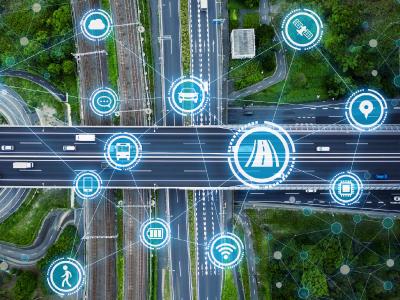
One of the huge challenges for the next generation of infrastructure is that most of the viable public space, in urban situations, is already built-out or dedicated to roads. This means that new infrastructure must retain backwards-compatibility with legacy mobility at least during a lengthy transition period. Thus, we’re left with using existing systems (mostly road surfaces) more intelligently. We need to adapt and transform the existing infrastructure using modern 21st Century tools - smart infrastructure.
As infrastructure is repurposed, and more efficient mobility solutions are considered, cities want to spend the “dividends” on other infrastructure (not mobility). Mobility will get less space to grow as cities reclaim the public space dedicated to vehicles for greenspaces, pedestrian areas, terraces, commerce, and parklets. This is most immediately visible in recent changes of opinions on free parking, and also in the closed streets during the COVID pandemic.
All of the thoughts above informs us of our requirements of 21st Century infrastructure. We are going to need solutions that deliver greater per-lane throughput & productivity of the surface area used by vehicles. Per-lane throughput can be increased by:
- smaller vehicles (smaller cars, bikes, scooters, multi-modality, etc.)
- more passengers per vehicle (public transit, shared rides, & carpooling)
- better public transit service, for example Bus Rapid Transit
- less space between moving vehicles (V2x, & autonomy can enable this)
- fewer parked cars (these use space, but deliver no throughput)
- higher utilization of cars and the aggregate vehicle fleet (keep ‘me moving stuff)
- faster speeds (but as we mix modes, this is fraught with risk)
- fewer empty trips, deadheads, drop-offs
- dynamic lane allocation
- smarter signaling
- incentives, demand management, tolls, dynamic pricing
At our meeting on Infrastructure, we expect to see a number of companies with solutions that can deliver on the demands listed above. We also expect to hear from a number of ancillary technologies that are needed as part of the end-solution, or on the roadmap there. And solutions like drone transports, while they may not be mass market, can also address some of the market. Other topics likely to be presented will include:
- energy, storage, charging
- CASE - connected, autonomous, shared, electrified
- the intersection, the highest-demand real estate
- curb access and utilization
- V2I and 5G
- sensors, information gathering
- Big Data, open data
- software, AI
- citizen-facing applications
Lastly, we should note that this topic is urban and city-tilted. Rural and remote mobility solutions are very different. And suburban lifestyles are currently built around the car, and aren’t likely to change overnight. The car will remain an important part of our mobility story, and is the one solution that bridges the urban, suburban, rural, and remote. There are also necessary innovations around how city mobility solutions transition to the exurbs, and connect the two.
Join us as we discuss the infrastructure for the 21st Century.
Sponsored by Wipro
As digital transformation and connectivity alter many facets of the Automotive Industry, Wipro works with clients to ensure they continue to innovate and remain at the forefront of change. Combining traditional solutions with the potential of Industry 4.0 technologies, we work with automotive manufacturers, OEMs and the extend supply chain to deliver vehicles that are safer and more enjoyable to drive.





Introduce your product or service to OEMs, Tier1s, and tech scouts. Applications are reviewed and invitations extended based on fit.
Demo your product to our audience in a private networking space by selecting a Meeting Table when you register.
Share your thought leadership or market analysis on this topic. Keynote, Analyst and Panel positions may be available.
Influence and access the auto industry's innovators by sponsoring this topic. Packages customized to meet your marketing goals.
Fees & Options
This is a live, interactive meeting available to attend in-person in Silicon Valley or online in our Virtual Meeting Room.
- ONSITE or ONLINE REGISTRATION: $200 (free for members)
Registration includes participation, pre and post meeting networking, pitches & demos, and complete agenda with attendee list. Contact information, presentations, and introductions are not included.
OPTIONS
- TECHNOLOGY PITCH: $250 ($50 for members)
5-minute Rapid Fire pitch to introduce a relevant technology, company, or product to in person and online audiences and Autotech Council members at large. - MEETING TABLE: $250 ($50 for members)
Tables are inside the meeting room, and can be used to show demos, followup on your pitch, or start conversation with other attendees before, during, and after the main agenda. They are 30” round / 42" tall cocktail table with black linen, power, and Wi-Fi when available, and signed with your logo.
Dual Access Meeting Format
This meeting is available to attend onsite in Silicon Valley or online in our virtual meeting room. No matter how you participate, our meetings are live and interactive allowing our presenters time for rapid fire pitches and Q&A from Autotech Council members with time for networking and private chats before, during and after the agenda.
This is a private meeting; it will not be recorded and is not available for later viewing.
Venue
Star Space
1250 Borregas Ave, Sunnyvale, California, 94089
Autotech Council meetings are hosted by companies around the Silicon Valley who are leading the way in mobility innovation.
Interested in hosting this or future meetings in 2022?
Host requirements include meeting facilities for 100 executives, catering, AV and tech support, and hosts benefit in many ways when they welcome 100 mobility executives to their offices and share their industry leadership. Request to Host

Health & Safety Policy: Onsite meetings are currently restricted to fully vaccinated persons, and we follow State, County and Host guidelines with regard to masking. Please check the meeting reminder email for specific requirements.
Remote Access
Registration is available until midnight prior to the meeting. Online attendees receive a "Remote Meeting Instructions" email with their private link to our Virtual Meeting Room 24 hours before the meeting.
Contact council@autotechcouncil.com with questions.