
This month, Autotech Council members open their discussion on Material Science to the public. Join OEMs, suppliers, startups and VCs to discover technologies, across connectivity, data and analytics, and apps and service.
The average car has 30,000 parts, and every one of them is made up of some material, with specific characteristics right down to molecular level. Small differences in composition and performance can have big impacts, for example the O-ring seals that stiffened in the cold, and caused the explosion of the Space Shuttle Challenger. Materials matter. And the automotive industry has steadily benefited from improved materials for over a century, but with a shift towards electric propulsion, and a thorough re-thinking of the car, new materials matter more than ever.
And there are incredible inventions all over, from ceramic metal blends that tolerate insane heat to Transparent Aluminium (ALON) that...well, it’s transparent There’s so much changing, but let’s consider two of the most important underlying trends that will jump-start materials innovations: Electrification, and Ride-Sharing
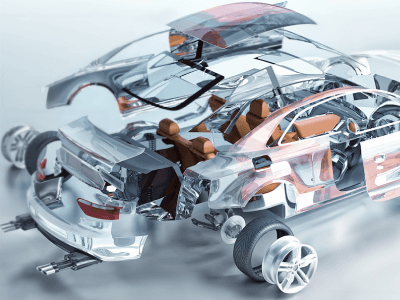
Electrification: requires re-thinking the drive train. It becomes less important to tolerate the heat of combustion, and to lubricate the engine, but more important to build efficient batteries, cabling, and electric components. A solar roof doesn’t make sense on an ICE, but surface materials that can generate at least enough energy to counteract vampire drain would be a big advantage.
Ride-Sharing: is interesting today, and growing. But once cars are self-driving, we know that private car ownership will decline, and shared cars will rise. These cars will see a much higher rate of utilization each day, covering more hours, more miles, and more passengers. Interiors will have to be easier to clean and replace, and seating must handle the increased workload. How will the materials need to change to be durable enough to handle the “commercial grade” workload?
Meanwhile other trends are also demanding new solutions.
- Big Metal: Car bodies and frames haven’t been simple steel for decades. New metallurgy or even carbon fiber can strengthen, lighten, and/or make cars safer
- Lightweighting: changing the weight of moving parts and unsprung parts
- Glass: glass is increasingly sophisticated, with variable shading, heat rejection, & displays built in
- Tires: A source of micro-particulates, tire innovation truly is where the rubber meets the road
- Brake pads: A source of micro-particulates that can be improved, and brakes are used differently in EVs. We’ve already gone from using asbestos to using cashew husks!
- Seating Materials: that are easy to clean, high-comfort, and resilient enough for rideshare use.
- Motor magnets: Car motors (EV) are new. There is still low-hanging fruit in automotive motors, like substitutes for rare earth magnets.
- 3d printing (and the media used, ex: Carbon Fiber Reinforced Plastics) has interesting implications
- Carbon fiber, silicon carbide nanoparticles, graphene, plastics, rubber and seals, ceramics, etc.
- Sustainability: At the end of life, can the materials be recycled efficiently?
For the entire existence of the car, the vehicle industry has collaborated with the materials scientists, and as the pace accelerates, that collaboration is growing closer and closer. The auto industry is now co-developing with R&D labs around the world. For today’s meeting, we will hear from some of the established innovators, and from startups trying to break into this rapidly evolving mobility sector.




Introduce your product or service to OEMs, Tier1s, and tech scouts. Applications are reviewed and invitations extended based on fit.
Demo your product to our audience in a private networking space by selecting a Marketing Package when you register.
Share your thought leadership or market analysis on this topic. Keynote, Analyst and Panel positions may be available.
Influence and access the auto industry's innovators by sponsoring this topic. Packages customized to meet your marketing goals.
Fees & Options
- ONLINE-ONLY REGISTRATION: $200 (free for members)
- MARKETING PACKAGE: $700 ($100 for members) For technology companies ready to pitch a relevant product and follow-up with interested attendees in real time. This package includes a 5-minute agenda spot, live follow-up networking, a second admission and promotion to 10k+ subscribers via email, social media, and blog post.
About Remote Meeting Access
This meeting we be held in Autotech Council's Virtual Meeting Room. Registered attendees will receive an email reminder with instructions 24 hours before the meeting with the subject line: Remote Meeting Instructions.
If you can't find your instructions, drop an email to council@autotechcouncil.com.
This is a live, interactive meeting; it will not be recorded and is not available for later viewing.